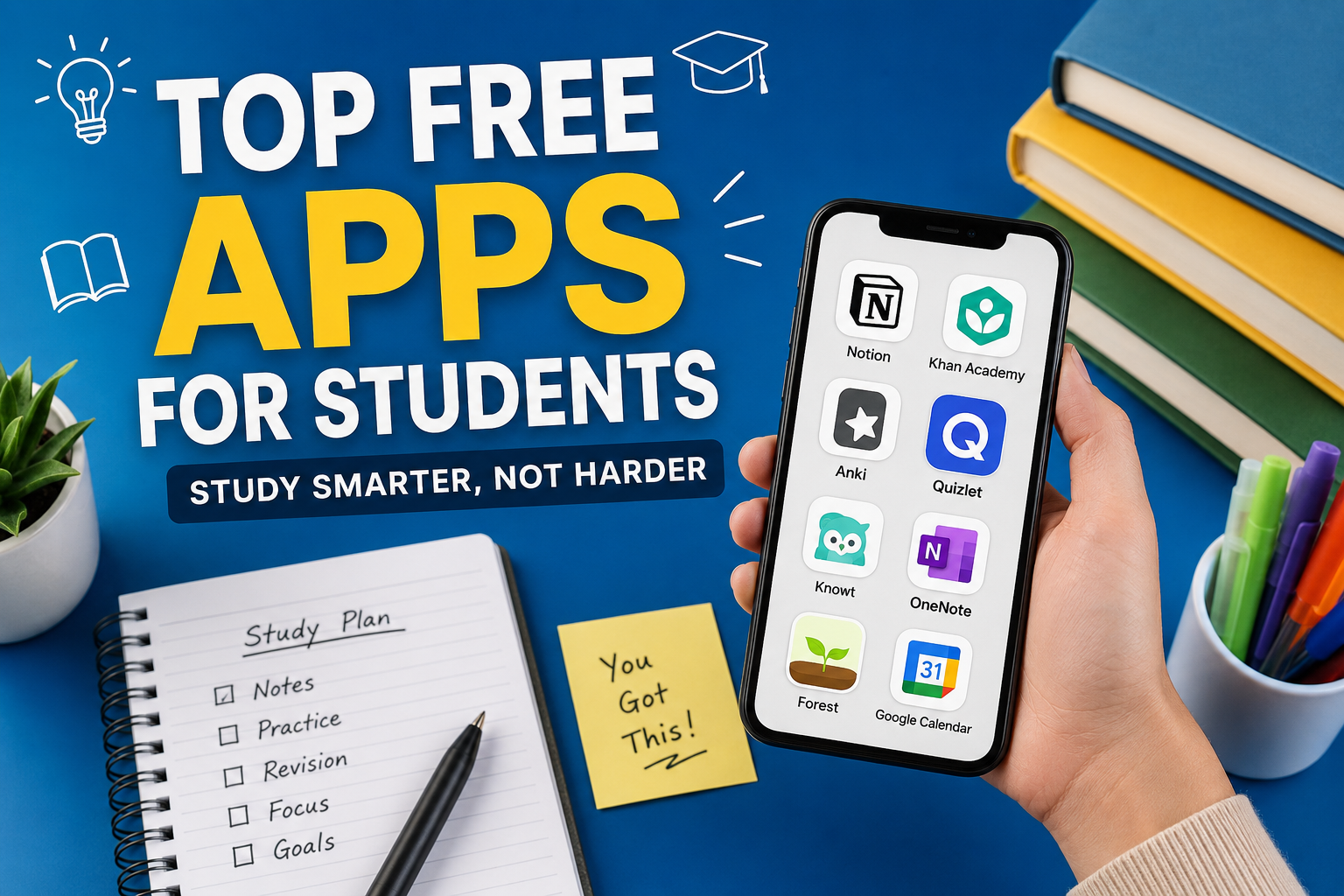
Top Free Apps for Students in 2026 That Actually Improve Learning
The Best Free Student Apps for Studying, Productivity, Notes, and Focus
Student life has changed. Between assignments, online classes, exams, group projects, and constant notifications, staying organized often matters as much as studying itself.
The good news is that students no longer need expensive software subscriptions to stay productive. Some of the most useful learning and organization tools now offer genuinely valuable free plans that cover note-taking, flashcards,Top Free Apps for students, focus sessions, scheduling, and concept learning. Recent reviews and student usage trends continue to show that free study apps remain one of the easiest ways to improve efficiency without increasing costs.
This guide covers the top free apps for students available today, who they work best for, and how to combine them into a practical study system.
Why Free Student Apps Matter More Than Ever
Modern learning is no longer limited to textbooks and classroom lectures. Students increasingly switch between devices, consume digital materials, and rely on flexible study routines.
A good app should solve a real problem. That could mean helping you remember information, manage deadlines, reduce distractions, or understand difficult concepts faster.
The strongest free apps usually fit into five categories:
- Note-taking and organization
- Flashcards and memory
- Focus and time management
- Concept learning and tutoring
- Planning and scheduling
Choosing one app from each category often works better than downloading dozens of tools.
1. Notion — Best Free All-in-One Workspace
Why students love it
Notion remains one of the most popular free productivity tools because it combines notes, calendars, databases, assignment tracking, and project management in one place. Students use it to organize entire semesters instead of juggling multiple apps.
You can create:
- Subject dashboards
- Assignment trackers
- Study schedules
- Shared project pages
- Reading lists
Best for
College and university students managing multiple subjects.
2. Khan Academy — Best Completely Free Learning App
Why it stands out
Khan Academy continues to be one of the rare educational platforms that provides full learning access at no cost. It offers structured lessons, practice exercises, and guided learning across subjects including mathematics, science, economics, computing, and test preparation.
Unlike many freemium platforms, core educational content remains fully accessible.
Best for
Students who want clear explanations when classroom teaching feels too fast or incomplete.
3. Anki — Best Free App for Long-Term Memory
How it helps students learn
Anki has built a reputation around spaced repetition, a study method designed to improve long-term retention through timed review sessions. Multiple app comparisons continue to rank it among the strongest memorization tools available.
Students commonly use Anki for:
- Medical studies
- Languages
- Science formulas
- Vocabulary
- Exam preparation
Best for
Students preparing for cumulative exams or content-heavy courses.
4. Quizlet — Best for Fast Flashcard Study Sessions
What makes Quizlet popular
Quizlet focuses on speed and simplicity. Students can create study sets quickly or search a massive library of existing flashcards and practice materials. Free users still get access to study modes and shared content libraries.
If Anki feels too technical, Quizlet usually has a gentler learning curve.
Best for
Quick revision and vocabulary-heavy subjects.
5. Knowt — Best Free AI Study Companion
Why students are switching
Knowt has gained attention by offering free AI-powered flashcard generation, practice tests, note importing, and study modes that reduce manual work. It appeals to students who want faster study setup with minimal formatting.
Students can upload notes and generate review materials automatically.
Best for
Students who prefer AI-assisted studying.
6. Microsoft OneNote — Best Free Note-Taking App
A practical alternative to paper notes
OneNote remains one of the strongest free note apps because it supports typed notes, handwriting, images, PDF annotation, and cloud syncing.
Students often organize notebooks by semester and section pages by subject.
Best for
Students who prefer digital notebooks over traditional documents.
7. Forest — Best Free Focus App for Reducing Distractions
How it works
Forest turns focus sessions into a simple challenge: stay off your phone and your virtual tree grows.
Community discussions and productivity comparisons continue to recommend it because it introduces accountability without feeling overwhelming.
Best for
Students who struggle with procrastination and phone distractions.
8. Google Calendar — Best Free Planning Tool
Why planning matters
Missing deadlines creates unnecessary stress. Calendar apps solve that problem.
Google Calendar allows students to:
- Schedule classes
- Set assignment reminders
- Plan exam preparation
- Coordinate group work
Many students pair calendars with note systems for better organization.
Best for
Students balancing study schedules and personal commitments.
How to Build a Simple Student Productivity Stack
Instead of installing everything, combine tools intentionally.
A balanced setup could look like this:
| Need | Recommended Free App |
|---|---|
| Notes | OneNote or Notion |
| Learning Concepts | Khan Academy |
| Memory | Anki |
| Quick Revision | Quizlet |
| Focus | Forest |
| Scheduling | Google Calendar |
| AI Study Help | Knowt |
This setup covers most student workflows without paid subscriptions.
Common Mistakes Students Make With Study Apps
Downloading too many tools
More apps rarely create better results. Too many systems increase friction.
Spending time organizing instead of studying
A beautiful dashboard does not replace active learning.
Ignoring review systems
Flashcards only work when reviewed consistently.
Switching apps constantly
Give each app enough time before deciding whether it fits your routine.
FAQ
Q: What is the best completely free app for students?
A: Khan Academy is one of the strongest fully free learning platforms because it offers educational content without requiring payment for core access.
Q: Which app is best for memorizing study material?
A: Anki is widely recommended for memorization because of its spaced repetition system designed for long-term retention.
Q: Are free study apps enough for college students?
A: For many students, yes. Combining note-taking, flashcards, planning, and focus tools can create a complete study system without subscriptions.
Q: Which free app helps students stay focused?
A: Forest remains a popular option because it encourages distraction-free study sessions through simple gamification.
Q: Should students use AI study apps?
A: AI study apps can save time and generate practice materials, but they work best when paired with active learning and independent thinking.
Final Thoughts
The top free apps for students are not necessarily the most advanced ones. They are the apps that remove friction, reduce stress, and help you learn consistently.
Start small. Choose one app for organization, one for studying, and one for focus. Build habits before adding complexity.
The best study system is usually the one you actually keep using.



One Comment